Quinn Maybrook and Glenn Maybrook move to Kettle Springs
Clown in a CornfieldQuinn Maybrook and Glenn Maybrook’s move from Philadelphia to Kettle Springs is a relocation made under the pressure of bereavement and a narrow timetable. What Glenn presents as a practical opportunity and a chance to begin again becomes, for Quinn, a departure she did not choose: she hopes the new town will let her recover in private, while the move also takes her away from the life and athletic future she had expected to keep.
Decision and Terms
The move begins with a business offer that includes the deed to a house. Glenn receives the offer on a Monday and accepts it by Friday; within a week, the family is packing. The arrangement promises a business and a home, with the possibility of starting over reduced to the simple image of turning a key. Its speed is part of its consequence: Quinn is not consulted before the decision is made, and the change is already underway by the time Glenn asks for her agreement.
When he finally does ask, Glenn appeals to their need for a fresh start. Quinn can see the appeal, but the request comes after the choice has effectively been settled. Her father has framed a move halfway across the country as something he has to do, as casually as deciding on takeout without asking what she wants. The contrast between the scale of the decision and the ordinary, unilateral manner in which it is delivered exposes the imbalance between Glenn’s authority to act and Quinn’s limited power to object.
What Quinn Leaves Behind
In Philadelphia, Quinn had a place on the path toward varsity volleyball. Her mother had been the athlete in the family and had pushed Quinn into sports; volleyball became Quinn’s own game. Long-limbed and quick, she was not the tallest player on her team, but could jump high enough to bring her shoulders level with the net. Her coaches were crushed when she told them she would not be joining the varsity squad that year, and they even offered to speak to Glenn for her. Their intervention underscores how clearly others understood that the move cost Quinn something, even as the decision remained outside her control.
The relocation also cuts across Quinn’s expected route toward college. She imagines Kettle Springs not as a permanent destination but as a place to keep her head down for a year, recuperate, and later apply to Penn, Temple, or another Philadelphia-area college. That plan makes the move’s meaning double-edged: she can conceive of it as an interval before returning to the future she had mapped out, but only by accepting that her immediate life and ambitions have been displaced.
A Fresh Start and Its Limits
For Quinn, the sole attraction of leaving Philadelphia is the possibility of a new beginning. If a complete beginning is impossible, she hopes at least for a year in which she can detox and recover away from the scrutiny attached to her past. No one in Kettle Springs knows her as the girl whose mother slumped in the bleachers during the previous year’s regional tournament and vomited down her chin. Nor, Quinn believes, does anyone there know how Samantha Maybrook died. The anonymity she imagines is therefore not simply a change of scenery: it is a chance to live somewhere her mother’s illness and death do not already define her in other people’s eyes.
That hope remains Quinn’s own interpretation of what the move might offer. Glenn’s proposal is a package deal built around work, a house, and the need for a fresh start; Quinn’s version is temporary refuge, recovery, and the possibility of returning to college near Philadelphia. Their motives overlap in the language of beginning again, but not in their control of the decision or in what each expects the new place to repair.
Arrival and Significance
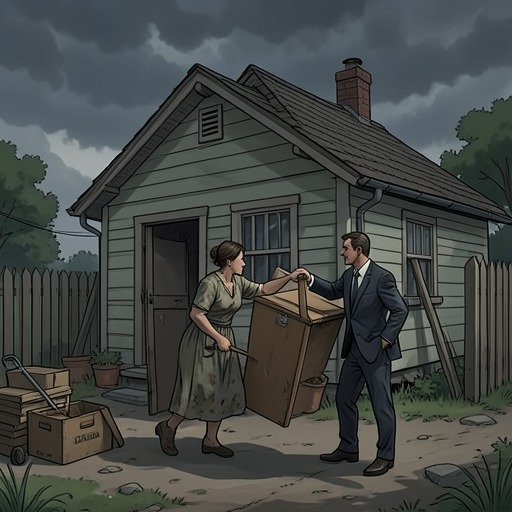
The physical move does not unfold with the ease suggested by the deal. Glenn dusts himself off, adjusts his glasses, and tries to present their arrival as settled, but Quinn can see his composure beginning to crack as he repeats to himself that they are there. She insists that the remaining load is not much, though the work has proved harder than expected and everything still has to be carried inside. Her effort to minimize the task works as practical encouragement, but it also sits beside the larger fact that she has had little time to prepare for the change itself.
As they maneuver the furniture, Glenn volunteers to walk backward in what appears to be a chivalrous gesture. The attempt highlights the physical awkwardness of the arrival rather than making it graceful: he is all elbows and unsteady feet, while Quinn has inherited her mother’s athleticism and has to shoulder the work. Once she gets her end of the couch through the threshold, she sets it down in the living room. The stale sweat and cat urine smell drives her to throw open the windows, giving their first entry into the house an immediate, unpleasant reality that the promise of a key and a fresh start had not conveyed.
Quinn thinks her mother would have found the moving scene hilarious. That imagined response makes Samantha’s absence present at the very moment the family reaches its new home. Quinn also recognizes the counterfactual beneath it: had her mother still been alive, the family would never have left Philadelphia for Kettle Springs. The move thus begins not as a clean break from the past, but as a consequence shaped by the person who is missing. Quinn can tell herself that she might start over, yet the arrival carries both the loss that made departure imaginable and the memories she hopes the new town will let her set aside.